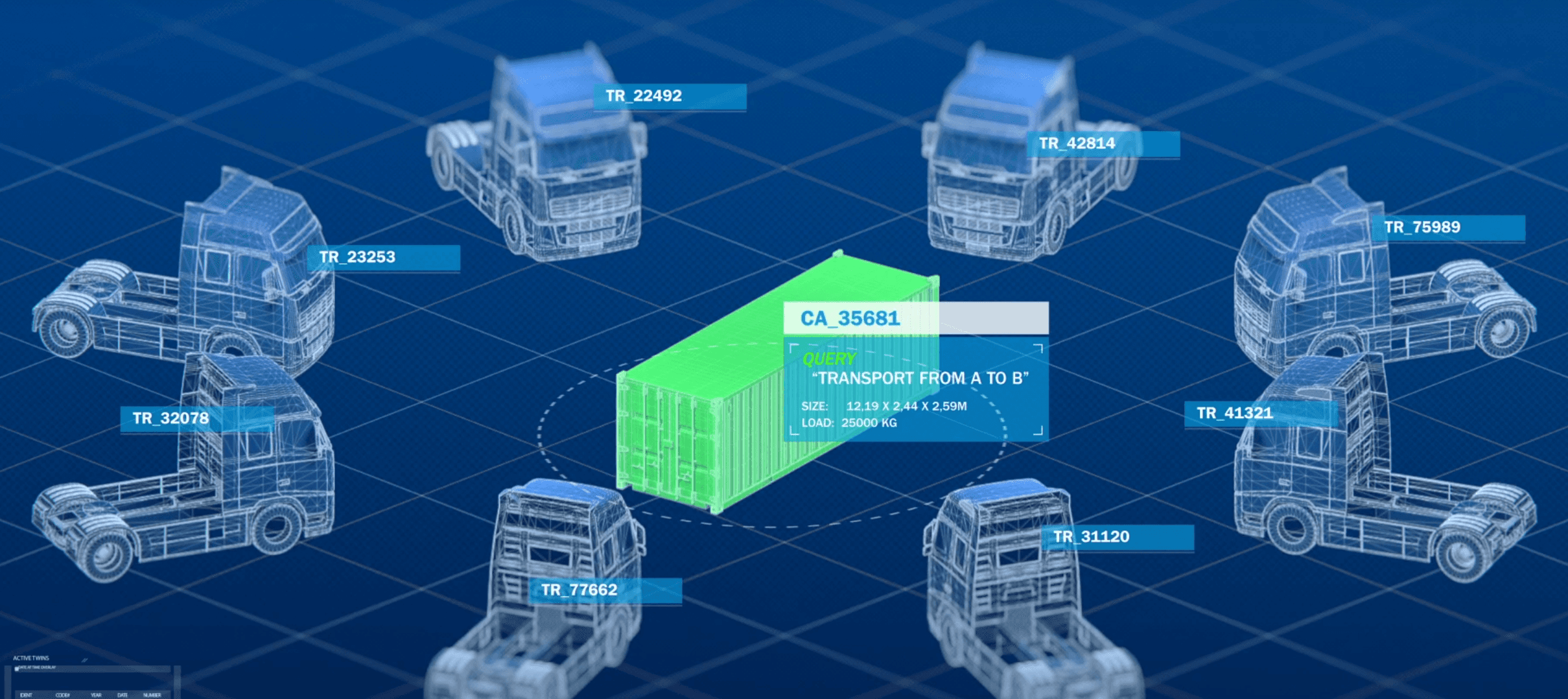
Van Berkel Logistics has conducted a study into the potential of automated truck planning for container transport, supported by the MIT Innovation Broker Scheme from TKI Dinalog. The study was carried out by us!
The original article appeared in Dutch on the website of TKI Dinalog, find it here.
Van Berkel Logistics explores automated truck planning with support from the MIT Innovation Broker Scheme
Growing complexity in logistics planning
The logistics sector is under pressure due to a shortage of planners, growing volumes, and an increasing number of last-minute changes. This creates challenges at Van Berkel Logistics: planners have less and less time for tasks like detecting anomalies or coaching drivers. There is also a heavy reliance on senior planners, which makes the organisation vulnerable.
In the current situation, the focus tends to be on getting the work done, preferably on time, which leaves little room for goals such as improving overal efficiency, sustainability, or capacity utilisation.
Technology as a supporting partner
Van Berkel Logistics sees opportunities in digitising the planning process. The idea is that planners become less like “decision-makers” and more like “operators”: they remain indispensable because of their experience and customer focus, but will be supported by software that can calculate complex choices faster and better.
Potential benefits include:
Reduced workload and increased job satisfaction for planners
Better utilisation of fleet capacity
Higher service levels for customers
A more sustainable network with fewer empty kilometres and lower CO₂ emissions
Key insights from the exploration
The study by Squid identified the steps needed to introduce automated truck planning:
Step-by-step implementation: start with smaller subprocesses and involve planners actively in development and setup
Improve information availability: connect to existing systems where possible and create input screens for information that is not digitally available yet
Modular IT architecture: build adapters and interfaces so software can be updated and expanded easily, for example for future deployment of electric trucks
Build user trust: ensure user-friendly interfaces, good onboarding, and transparency in how the algorithm makes decisions
According to Squid, success depends heavily on collaboration between humans and technology.
“Planners have essential knowledge and experience. Software can support them by making complex calculations and scenarios understandable so they can focus on the exceptions and the human side of the work. “
Opportunities and challenges
Automated truck planning offers many advantages, such as scalability when volumes grow, quicker training of new planners, and better KPI control. Software can also detect changes that affect the planning faster and, in some cases, automatically reschedule.
There are, however, challenges, such as handling “soft limits” (for example a container arriving slightly late), reducing algorithm computation time, and gaining user acceptance. It is crucial that planners and customers understand why an algorithm makes certain decisions and how parameters can be adjusted.
Where Squid stands now
Squid has been in operation at Van Berkel Logistics for over two years. Initially the focus was on digitising and visualising the information planners need. The project has since progressed to algorithms that automatically generate a basic schedule for regional work. Squid is currently working with the University of Oxford on an advanced seaport trucking algorithm.
A key lesson from the past two years is that much “soft information,” like customer and driver preferences, has to be captured and digitised first. It also became clear that planners cannot be replaced by an autonomous system. The real value lies in automating routine tasks so planners can focus on exceptions and intervene when the world turns upside down and the dynamic of logistics demands creativity.
This article is written by

Dutch Institute for Advanced Logistics
Follow on