Discover how research into autonomous algorithms and digital twins turned into Squid. From decentralised decision-making in container logistics to real-world transport planning software.
How Autonomous Algorithms led to founding Squid
Before Squid became software for transport planning for container logistics, there was a question: What if trucks could be truly autonomous?
Not just drive themselves.
But plan themselves.
Autonomously.
This question turned out to be a Dragon’s Den winning idea at TNO which generated the funding to start the Autonomous Algorithms research project. It eventually became the philosophical backbone of Squid.
This article explains that journey.
From Research Lab to Real-World Planning
Squid builds software that helps transport planners focus on exceptions instead of routine decisions. That idea did not originate from customer demand or conventional market, but from applied research into self-organising logistics.
The Autonomous Algorithms project explored what happens when decision-making in logistics moves from central planning to distributed intelligence, embedded in digital representations of trucks, containers and other assets.
This research was conducted in collaboration the logistics partners Van Berkel Logistics and DHL Global Forwarding. It addressed a fundamental question that still defines logistics today:
Should transport planning be centralised or decentralised?
Squid exists because reality sits somewhere in between.
Central Planning in a Messy World
A typical container journey illustrates the problem well:
A container leaves China by ship, arrives in Rotterdam, clears customs, travels by barge to an inland terminal, and finally a truck will deliver it to the customer.
This chain involves shipping lines, terminals, customs, barge operators, trucking companies, drivers, and planners.
Each party is responsible for part of the chain and optimises its own processes. Traditionally, human planners sit right in the middle of such a process. They collect information, weigh options, make decisions, and assign tasks.
At Van Berkel Logistics, for example, a booking enters through the booking desk. A planner reviews all bookings and assigns them to barges and trucks in a way that ensures on-time delivery and operational efficiency.
This works. Until it does not.
Because the real world is messy:
A customer may decide to change the delivery date
A terminal may be congested, causing longer dwell times for trucks
Weather may delay an ocean carrier which pushes earliest pickup times out
A driver may call in sick, right before the start of his shift
The point is that this is not your regular puzzle. Pieces change, move, appear, disappear. Your perfect solution may be useless moments later.
In theory, a central control tower with complete information could solve this.
In practice, complete information and complete control do not exist.
Humans Are Decentralised by Nature
Interestingly, humans themselves don’t operate like centralised planners at all.
That same transport planner:
Needs to pick up kids at 18:00
It is 17:00 and a bunch of CMRs still need to be prepped
Sees 10+ minutes of congestion on the A50
Coordinates with a colleage to take over his CMR task
Leaves work early to be on time at daycare
His plans and tasks are adjusted on the fly. Each human continuously:
Receives information
Processes it
Makes a decision
Acts
Learns
Every person does this differently, with different preferences and different trade-offs.
So the key question became: If humans work this way, why do we force logistics assets into rigid centralised systems?
Digital Twins with Decision-Making Power
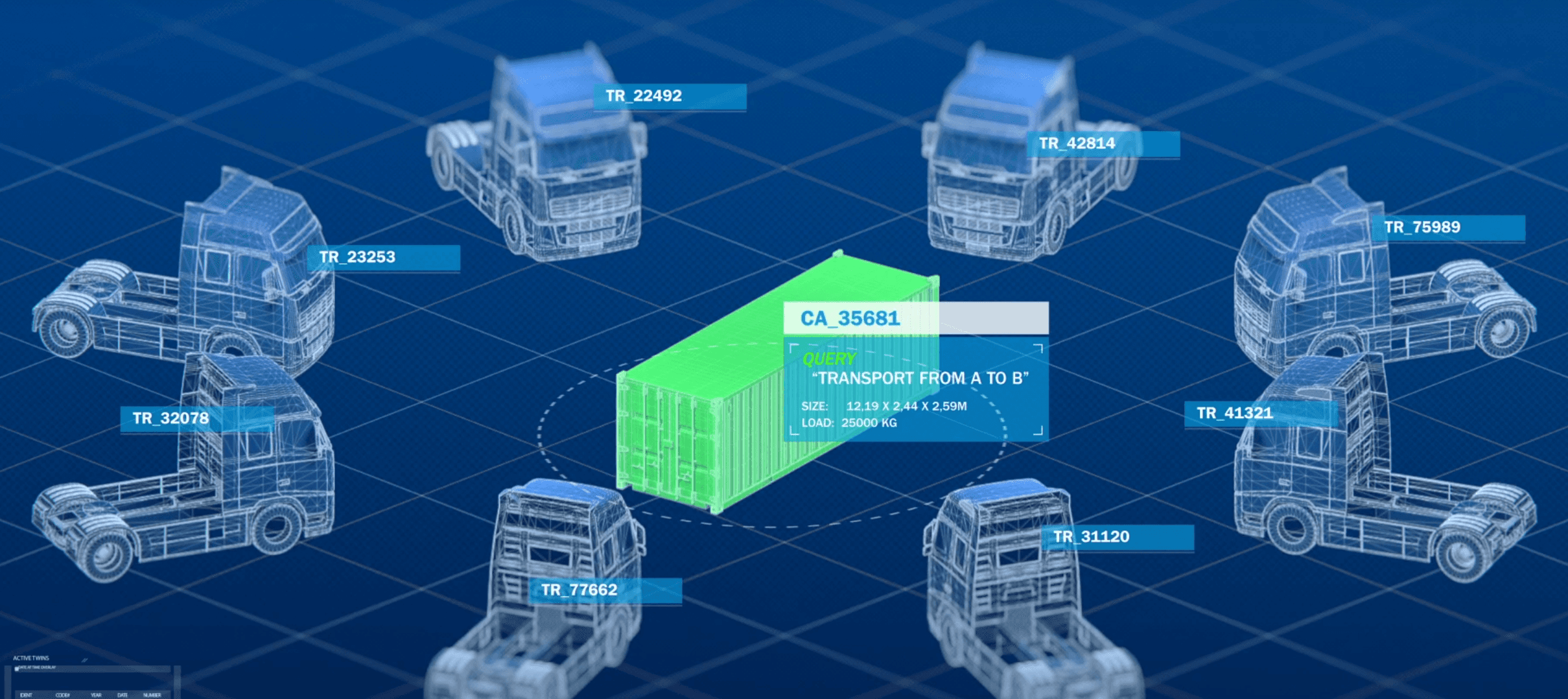
In the Autonomous Algorithms project, this question was explored by creating digital twins of real trucks.
A digital twin is a small software agent that represents a physical asset and consists of three components:
Data: Information about the truck, driver and assigned orders
Communication: The ability to talk to humans and other digital agents
Decision logic: A brain that evaluates options and constraints
These digital twins could not drive the truck, but they could think.
Each truck twin could:
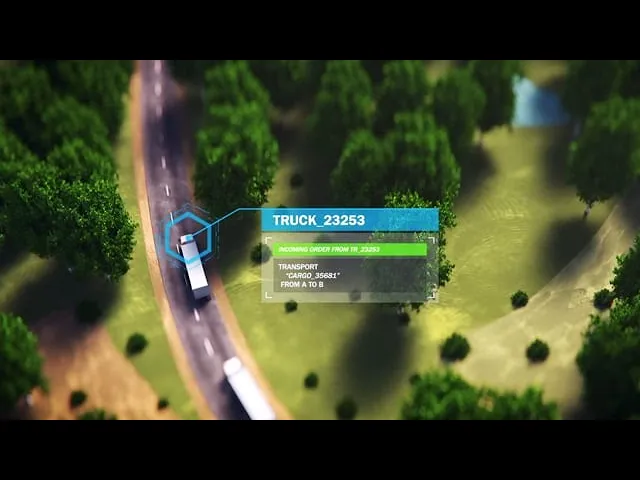
Receive orders from the booking desk
Check constraints (like the Euro-6 engine requirement for Maasvlakte)
Calculate the execution costs of each booking
Share costs with peer trucks
Tasks were then allocated based on who would lose the least by taking a less optimal alternative.
No central planner needed.
Why Decentralised Intelligence Makes Sense
Under perfect conditions, centralised planning is optimal.
But logistics never operates under perfect conditions.
Decentralised decision-making offers two critical advantages:
1. Local Problem Solving
Each truck has:
Different characteristics
Different drivers
Different cost functions
Different constraints
By reducing the problem from network-wide to asset-level, disruptions can be solved much faster.
If a truck is delayed at a congested terminal, it can immediately:
Flag the risk to its next order
Ask peer trucks for help
Reallocate work without waiting for human intervention
2. Limited, Purposeful Data Sharing
Digital twins do not need full transparency of entire order books. They only share what is necessary and when it is relevant.
This mirrors how planners collaborate by phone but faster, structured and scalable.
Beyond Trucks: Collaboration Across the Supply Chain
The real breakthrough appears when digital twins extend beyond trucks.
A truck receiving a Veghel → Maasvlakte order could:
Ask a barge for availability
Check crane capacity
Signal the container that a solution exists
If containers themselves have digital twins, they become data carriers across the supply chain, choosing between combined offers from trucks, barges or trains.
Multiple parties may propose solutions via different combinations of modalities. The container selects the best option based on predefined goals.
The Role of the Planner Changes
In this model, planners are not removed, but their role shifts from commanding every assignment to defining the rules, settings the boundaries, monitoring outcomes, and intervening when things go wrong.
There is a human component when asking a driver to work overtime, informing a customer of a delay or making a judgement about whether a certain risk is worth taking.
This insight is central to Squid today.
The Dragon’s Den Moment: From Theory to Proof
The Autonomous Algorithms project came into being after a 5-minute Dragon’s Den pitch in 2019.
The pitch made two bold assumptions:
All information will eventually be digital
All decision-making will be automated
The idea resonated with Van Berkel Logistics and DHL Global Forwarding, because autonomous algorithms:
Remove cognitive overload from humans
Make decisions faster
Learn continuously
Scale effortlessly
Enable new business models
But they also raise important questions:
Who sets the rules?
How do we encode things we value as a business?
Who owns an autonomous algorithm?
These are not just theoretical questions, they shape real software.
Read more about the Autonomous Algorithm project on TNO’s website.
Lessons Learned
Full centralisation is fragile in real-world logistics
Decentralised intelligence scales better under uncertainty
Humans should set rules, not micromanage outcomes
Automation works best when it mirrors how people already collaborate
These lessons continue to guide Squid’s product decisions today.
The Result: Squid
Squid is not a system where trucks plan themselves.
But it is software built on the same principles:
Decentralised decision support
Rule-based automation
Fast reaction to change
Planners focused on exceptions, not routine
A lot of work TNO does ends up in reports, presentaitons, or whitepapers like this one:
Letting Digital Twins Run the Show: Exploring Possibilities of Letting Vehicles Plan and Organise Themselves
Autonomous Algorithms showed what is possible.
Squid makes it practical.
If you’re dealing with constant replanning, late surprises, or overloaded planners: You’re facing the same problem Autonomous Algorithms set out to solve.
Let Squid plan, so you can focus on solving what actually matters.
This article is written by
Christian is the founder of Squid. That means being a jack of all trades. Sometimes that trade is writing blogs.
Follow on